Tool transfer and process stabilisation in automotive series production
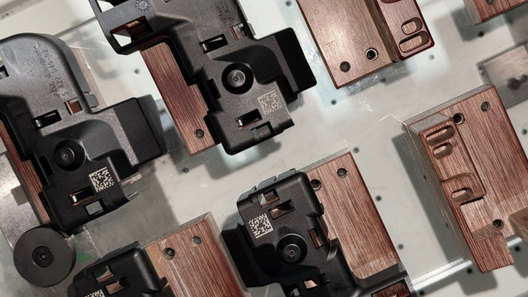
An existing partner approached us to transfer an ongoing automotive series production project as quickly as possible (ASAP), due to quality problems and failure to meet OEM requirements.
To take over an ongoing project seamlessly and establish a stable, defect-free injection moulding process for series production that meets OEM requirements for our existing customer.
Project parameters
360 000 units/year
Production volume
PA46
Material
4 cavities
Tool configuration
150 T
Injection moulding machine
100%
QR code readability inspection
IATF
Automotive compliance
Challenges
During the transfer, we had to stabilise three critical areas within a short timeframe.
QR code readability
Illegible markings rejected by the OEM on several occasions
Insufficient contrast and marking quality at the previous supplier
Recurring quality concerns during series production
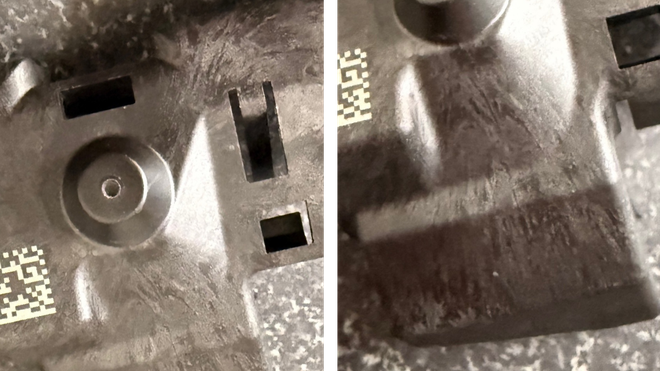
Surface discolouration
Clearly visible surface defect of approximately 3×3 cm on the injection-moulded part
Inconsistent visual quality leading to complaints
Material preparation was suspected to be the cause
Incomplete documentation
The tool was transferred with incomplete documentation
Series production parameters had to be redefined
Stable, repeatable settings were needed at short notice
We delivered a lasting solution through engineering analysis, process parameter redefinition and 100% inspection.
Mitter's solution
01 Redefining process parameters
Integrating the tool into a Netstal 150 t production environment
Establishing settings suitable for series production
Documenting critical parameters and inspection points
02 QR code marking and fixture
Introducing new laser marking parameters
Developing a positioning fixture
Introducing 100% automated readability inspection
03 Drying protocol and moisture control
Integrating a Wittmann dryer
Standard drying: 4 hours / 120°C
Stabilising moisture content below 0.02%
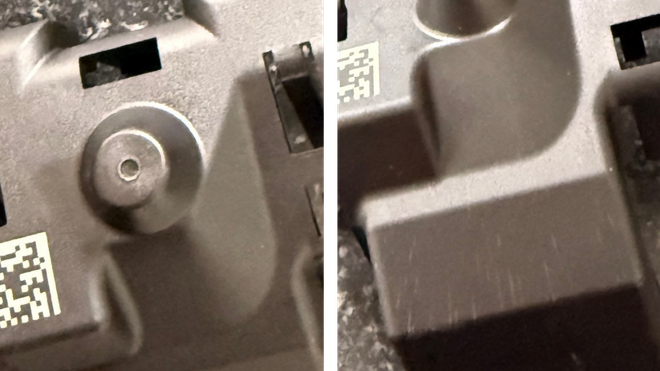
Eliminating the surface defect – before and after
The drying protocol and process stabilisation eliminated the discolouration, producing a uniform surface.
Előtte: Felületi foltosodás sorozatgyártásban
Utána: Homogén felület stabil technológiával
Customer feedback
“A great result: the QR code is much clearer, and the surfaces of the parts are also far more uniform than with the previous supplier.”
— Tier-1 partner, OEM audit
Planning a production transfer? Let's discuss the technical details.
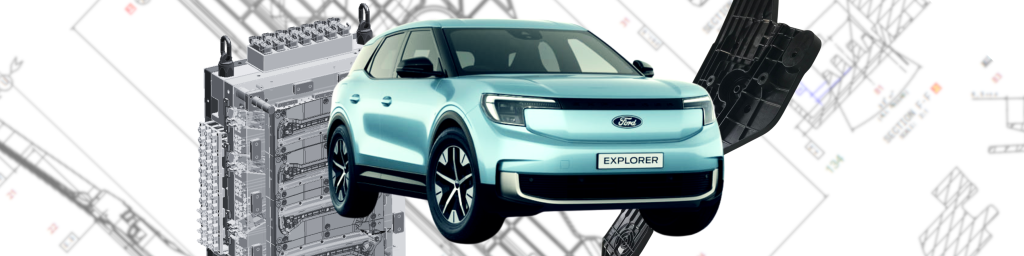
A milestone for Mitter: how we delivered the Ford Explorer electric window regulator project
Manufacturing the FORD CX470 family of components is the largest and most complex automotive project in Mitter's history. During more than a year and a half of preparation and manufacturing, we not only tackled technical challenges but also introduced numerous new technologies, machines and capabilities. The project became a milestone: it included the largest tool we had ever built, triggered major investment for series production and, last but not least, became our first large-scale robotised production operation.
The starting point: high expectations and high stakes
From the outset, we knew this would be no ordinary task. Customer requirements were extremely strict, and tolerance limits were often difficult to meet. Even during prototyping, extensive consultation was needed: we worked with the customer to fine-tune critical dimensions and measurement methods.
The project's complexity and scale are also reflected in our use of external designers for two of the three tools and subcontractors for several stages of series-tool manufacture. This allowed us to meet the deadline while continuing to serve our other customers without disruption.
This required flexible yet exceptionally intensive teamwork.
Our engineers described these tools as a textbook collection of technical challenges
Three tools were made for series production, for three different products:
two 2-cavity tools for the larger components,
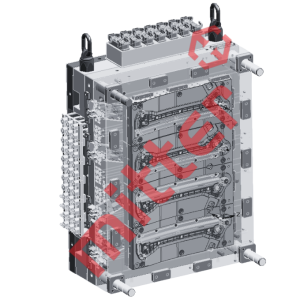
one 4-cavity tool for the smaller but exceptionally complex component, which became the largest tool in Mitter's history, <span style="font-weight: bold; font-family: Calibri; font-size: 11.0pt;">weighing 4800 kg.
All three tools use valve-gated hot-runner systems because they process long-glass-fibre-reinforced PP. Injection moulding simulations at the start of the project confirmed that only sequential valve gating could achieve optimum filling and acceptable weld-line quality.
Our engineers consider these tools a textbook collection of technical challenges:
mechanical slides,
hydraulically operated core pins,
insert-holding elements,
a complex, segmented cooling system.
The cooling system of the 4-cavity tool is so complex that the cooling pipework requires the system to be dismantled before every tool change – a separate operation in itself. Due to its size, the tool only just fits between the tie bars of our new Demag 650 machine.
Investment: a new machine, a new crane and new capabilities
Significant investment was needed to deliver the project.
We purchased aDemag 650 electric injection moulding machine with a special screw capable of processing long-glass-fibre material with minimal damage.
To move the enormous tools, we built a new crane runway and commissioned a new crane.
We installed aSepro robot and several temperature control unitsfor precise temperature control.
This project was our first substantially robotised production process, bringing new knowledge and a new approach to our daily work.
Series production: from the first delivery to stable operations
The first actual series delivery took place in May 2024.
Naturally, not everything went smoothly when production started:
fine-tuning the robots took time, so the initial scrap rate was higher than expected,
a total of 902 measurement points had to be managed across the three products, which was an enormous task,
measurement fixtures and programmes were developed and refined in close cooperation with the customer, with weekly online meetings and monthly face-to-face discussions.
Overall, we achieved an average cycle-time improvement of 10% across all three products compared with the start of production. It is important to note that this did not involve exceeding technological limits: the robot's initial safety settings had made the actual starting cycle time longer than calculated. Once we fine-tuned the robot using production experience, we achieved the cycle time committed to in our quotation.
After the initial difficulties, production gradually stabilised and now runs smoothly and according to plan.
Lessons learned
The CX470 project led to considerable internal development:
A brand-new electric injection moulding machine and expanded infrastructure,
The introduction of complex robotised production,
Stronger engineering and quality assurance capabilities,
Experience of working with external specialists.
For the team, this was a personal challenge as well as a professional one.
As one colleague put it: “It was both a major challenge and an inspiring task.” Another added: “We have never had so many customer meetings on a single project.”
From milestone to springboard
As a result, the project successfully entered series production and continues to run reliably at a high level of quality. Alongside customer satisfaction, it also contributed to Mitter's internal development: we gained knowledge and capabilities that will benefit major future projects.
The CX470 project was a milestone for Mitter: it demonstrated our ability to solve the most complex automotive challenges. The knowledge and experience gained provide a solid foundation for taking on complex projects with even greater confidence in the future.
Request a quote for toolmaking & plastic injection molding
Please enter your contact details and request – we will get in touch with you shortly.
Thank you for your interest. A member of our team will contact you within 24 hours. Further communication will be conducted in English.
Angebot für Werkzeugbau & Kunststoff-Spritzguss anfordern
Geben Sie bitte Ihre Kontaktdaten und Ihr Anliegen an – wir setzen uns zeitnah mit Ihnen in Verbindung.
Vielen Dank für Ihr Interesse. Ein Mitarbeiter unseres Unternehmens wird sich innerhalb von 24 Stunden mit Ihnen in Verbindung setzen. Die weitere Kommunikation erfolgt in englischer Sprache.